Gelagen › Blog › Twenty Milligrams Of Vitamin C: The Collagen Mechanism And What Dose It Takes
Gelagen long readTwenty Milligrams Of Vitamin C: The Collagen Mechanism And What Dose It Takes
The mechanism linking vitamin C to collagen is real, and the amount on the label still has to be judged on its own.
The line, and the sentence it invites
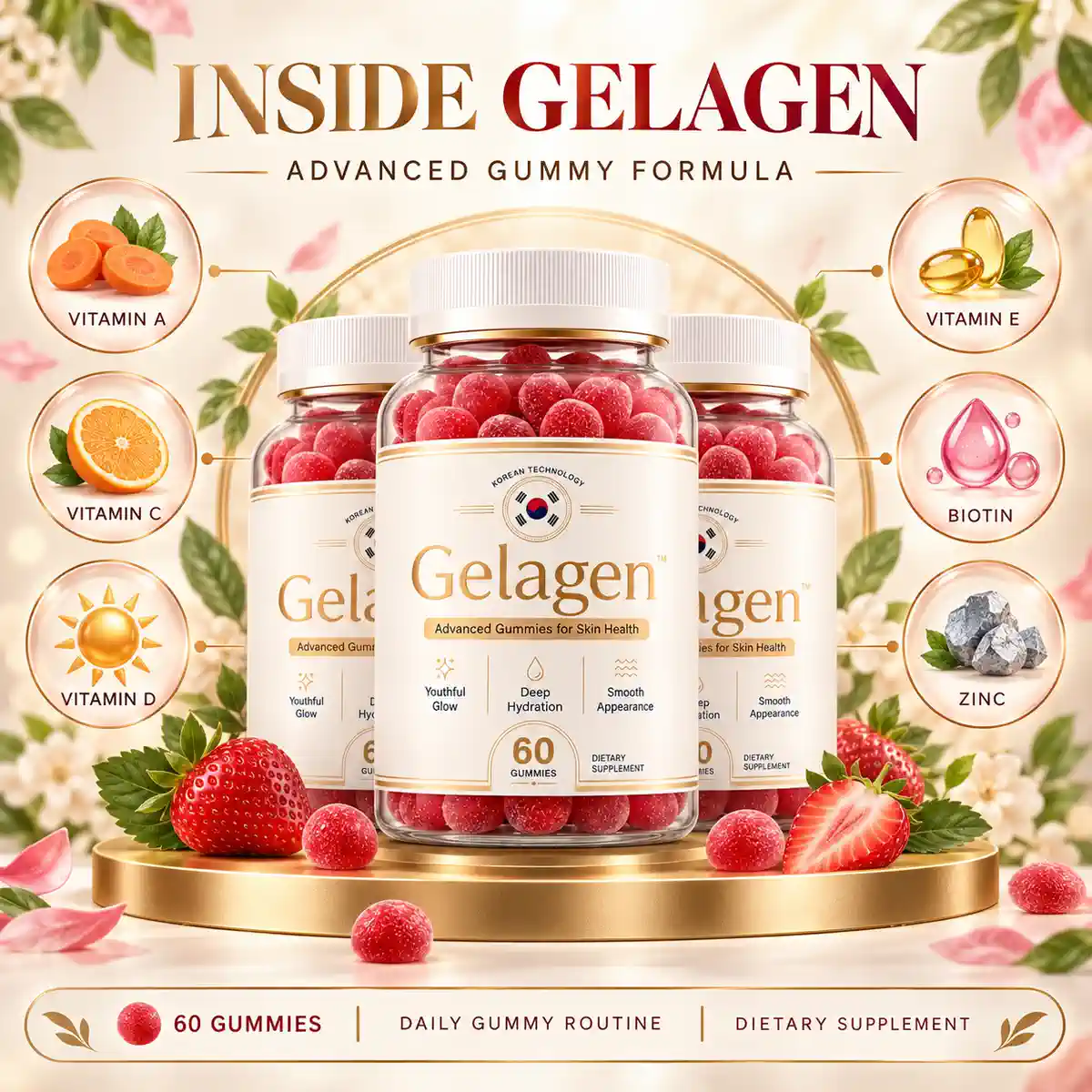
The Gelagen panel prints vitamin C as ascorbic acid, 20 mg per serving of two gummies, and beside it 22 per cent of a Daily Value. The reference intake behind that percentage is 90 mg a day for men and 75 mg for women, and 20 divided by 90 is about 22 per cent. The entry is honest and modest, and it sits on a product sold for skin, hair and nails, which invites a particular sentence: vitamin C makes collagen, so it must be good for skin.
Each half of that sentence is true, and the conclusion still does not follow from the amount on the label. This piece separates the mechanism, which is well established, from the dose question, which is where a 20 mg line has to be judged. The panel lists no collagen among its thirteen ingredients, so the vitamin C row is the only place the collagen connection is made at all, and it deserves a careful reading.
The mechanism is real
Collagen is a protein built from chains that have to be twisted into a stable triple helix, and vitamin C is a required helper in that process. A 1991 review in The American Journal of Clinical Nutrition states the core of it: ascorbate is required for the hydroxylation of proline residues in procollagen, and the resulting hydroxyproline stabilises the collagen triple helix. Without enough ascorbate the collagen cannot be secreted properly, and deficiency is associated with defective connective tissue, particularly in wound healing. The extreme case of this is scurvy, and it is the reason the connection has been known for so long.
Laboratory work has shown it in cells. A 1998 study in the International Journal of Cosmetic Science found that vitamin C induced a dose-dependent increase in collagen type I deposits by normal human fibroblasts grown in a dish, and it attributed vitamin C’s role to preventing the inactivation of two collagen-building enzymes, lysyl and prolyl hydroxylase. It is a cell-culture study, which matters, and it is useful mainly for showing that the biochemistry checks out at the level of a single cell type.
A 2017 review, “The Roles of Vitamin C in Skin Health”, pulls this together for skin in particular. It notes that normal skin contains high concentrations of vitamin C, that the vitamin stimulates collagen synthesis and assists antioxidant protection against ultraviolet-induced photodamage, and that this knowledge is often used as a rationale for adding vitamin C to topical products. It then makes an important qualification: the efficacy of topical treatment, as opposed to optimising dietary vitamin C intake, is poorly understood, and the review identifies areas where a lack of evidence limits what can be said. It ends by suggesting which skin properties are most likely to benefit from improved nutritional intake, which is a much narrower claim than the one the sentence above makes.
So the mechanism deserves respect. What it establishes is that the body needs vitamin C for collagen, and that a person who is short of it will make poor collagen. It does not establish that adding a small amount to a person who already has enough makes more or better collagen. That step needs a dose-response answer, and the dose-response work is the next part of the story.
What the dose-response work found
Vitamin C is one of the best-studied nutrients for how the amount you take relates to the amount in your blood, and the classic study is small but unusually thorough. A 1996 study in the Proceedings of the National Academy of Sciences kept seven healthy volunteers in hospital for four to six months on a diet with less than 5 mg of vitamin C a day, and then gave them daily doses from 30 up to 2500 mg, measuring steady-state levels in plasma and tissues.
The plasma concentration followed an S-shaped curve against dose. The steep portion lay between the 30 and 100 mg daily doses. The first dose beyond the sigmoid portion was 200 mg a day, and complete plasma saturation occurred at 1000 mg. White blood cells, that is neutrophils, monocytes and lymphocytes, saturated at 100 mg a day and held concentrations at least 14 times higher than plasma. A single 200 mg dose was completely bioavailable, whereas at single doses of 500 mg and higher, bioavailability declined and the absorbed amount was excreted. Vitamin C did not appear in the urine of six of the seven volunteers until the 100 mg dose.
Two things stand out for a 20 mg reading. The first is that 20 mg is below the lowest dose the study tested, so it is outside the range where the curve was measured, and on the near side of the steep part. In a person whose diet supplied almost no vitamin C, the first milligrams count for the most. The second is the reverse: for a person who already eats a reasonable amount, the curve flattens, and 20 mg adds a little to a level that is already well up the curve. Which of these describes you depends on what you eat, which is exactly what a printed amount cannot tell you.
| Daily dose | What that study found |
|---|---|
| Below 30 mg | Not tested. The lowest dose was 30 mg. |
| 30 to 100 mg | The steep part of the plasma curve. Blood cells saturate at 100 mg. |
| 200 mg | The first dose beyond the sigmoid portion. Completely bioavailable as a single dose. |
| 500 mg and above | Bioavailability declines, and the absorbed excess is excreted. |
| 1000 mg | Complete plasma saturation. Oxalate and urate excretion were elevated. |
Seven volunteers, in hospital for four to six months, so a rigorous design and a small sample. Read it as a shape, not a prescription.
A 2004 follow-up study in the Annals of Internal Medicine with 17 healthy hospitalised volunteers gave doses from 0.015 to 1.25 g by mouth and by vein. It concluded that oral vitamin C produces plasma concentrations that are tightly controlled: a 1.25 g oral dose produced a mean peak of 134.8 micromol/L, against 885 micromol/L from the same amount given intravenously. The body regulates how much of an oral dose reaches the blood, and beyond a point, more by mouth does not mean more in the plasma.
Why the reference intake is 75 and 90 mg
The same research group and others argued about the right figure during the years before the current reference intakes were set. In its 1996 paper the Levine group proposed raising the then-current 60 mg to 200 mg, which they noted could be obtained from fruits and vegetables. A 1999 article in JAMA by the same lead author applied a nine-point set of criteria and proposed an RDA of 120 mg with an upper level below 1 g, and it observed that five servings of fruits and vegetables a day could supply about 200 mg. A 1999 review in The American Journal of Clinical Nutrition by Carr and Frei looked at the evidence on chronic disease and concluded that 90 to 100 mg a day was needed for optimum reduction of chronic disease risk in nonsmokers, and it also proposed 120 mg. It noted that the RDA of 60 mg then in force rested on a mean requirement of 46 mg a day to prevent scurvy.
The values on this site’s panel, 90 mg for men and 75 for women, are the ones in force today, and they sit between the old figure and the proposals. What matters for a 20 mg entry is what all of those papers share: none of them puts 20 mg in the range where anything beyond preventing deficiency has been claimed. Twenty milligrams is a fraction of the amounts that were being argued over, and it counts as a contribution toward the day’s total from all sources, not as a dose in its own right.
What the skin trials used
If the mechanism is real and the amount is small, the direct question is whether anyone has tested vitamin C in this range for skin. The trial record I could find uses other amounts and other designs, and reading it makes the mismatch plain.
A 1998 randomised, double-blind study in ten people gave 2 g of ascorbic acid together with 1000 IU of d-alpha-tocopherol daily, or a placebo, for eight days, and measured the ultraviolet dose needed to cause sunburn. It rose in the vitamin group and fell in the placebo group. The vitamin C dose there was 100 times the amount on this label, it was combined with vitamin E, and the outcome was sunburn threshold, not collagen.
A 2024 randomised, placebo-controlled, double-blind trial in Nutrients tested a daily dose of 5 g of hydrolysed collagen with 80 mg of vitamin C, with and without hyaluronic acid, over 16 weeks in 87 women aged 40 to 65. It found improvements in dermis density, skin texture and wrinkle severity, and no significant effect on elasticity or hydration. Two features make it hard to use as support for a 20 mg line. The tested product was 5 g of collagen plus 80 mg of vitamin C, so the trial could not separate what the collagen did from what the vitamin C did, and 80 mg is four times this label’s figure. The Gelagen panel contains no collagen.
The evidence on vitamin C and collagen elsewhere in the body is thin too. A 2018 systematic review in the Orthopaedic Journal of Sports Medicine looked at vitamin C after bone, tendon and ligament injuries. Of ten included studies, most of the positive findings on collagen synthesis and healing were in animals and cell studies, one clinical fracture study found no significant difference in healing rate, and the reviewers concluded that oral vitamin C appears safe but lacks clinical evidence compared with controls.
| Study | Vitamin C used | Outcome |
|---|---|---|
| 1998 sunburn trial, 10 people | 2 g a day, with vitamin E | Ultraviolet dose to cause sunburn rose. |
| 2024 collagen trial, 87 women | 80 mg a day, with 5 g collagen | Dermis density, texture and wrinkles improved; elasticity and hydration did not. |
| The Gelagen panel | 20 mg per serving | No trial of the finished product is published by the seller. |
The last row is a statement about the label, not a result. The two studies above it are cited below.
Gelagen
The panel prints vitamin C as ascorbic acid, 20 mg per two-gummy serving, at 22 per cent of a Daily Value.
Order GelagenWhat 20 mg can honestly be said to do
Put the pieces together and the fair statement is modest. Twenty milligrams is 22 per cent of a day’s reference intake. It contributes to a total that also includes whatever you eat, and vitamin C is a required cofactor in making collagen, so the contribution goes to a real job. If your diet is short of vitamin C, a small amount helps you move up the steep part of the curve. If your diet is not short, the amount is small enough to be almost lost in it.
What the evidence does not let you say is that this amount improves collagen, firmness or wrinkles. The mechanism papers explain why vitamin C is needed. The dose papers show adequacy is reached by amounts several times higher, from all sources. The skin trials used other doses, other forms, and, in both cases, other ingredients alongside. The claim that a 20 mg line does something visible has no study behind it in what I read for this piece, and the seller publishes no trial of the finished product, so this page does not make it.
Gelagen is a vitamin and mineral gummy sold for skin, hair and nails. This piece explains a line on its label and the studies around it. It does not claim that the gummy improves skin, and it is not a substitute for advice from a clinician, especially for anyone who takes prescription medicine or has a diagnosed condition.
What to do with the number
- Read 22 per cent as a contribution to a daily total that also includes food, not as a treatment dose.
- Remember that the curve flattens: the first milligrams matter most, and doses above a few hundred milligrams are largely excreted.
- Judge a “collagen” claim by the dose in the trial behind it. The trials cited here used 80 mg and 2 g, not 20 mg.
- Notice what is absent. The panel has no collagen, so any collagen story attached to it comes from the mechanism, not from an ingredient.
Vitamin C is needed to make collagen, and 20 mg is a modest, honest contribution to the day’s intake, but nothing in the studies cited here shows that 20 mg changes collagen or skin in someone who already eats enough.
The vitamin C row is one of thirteen. The thirteen-amounts piece sets it beside the others, the vitamin E piece follows one form question through, and the B12 piece covers a nutrient whose absorption is capped.
Sources
- Peterkofsky B. Ascorbate requirement for hydroxylation and secretion of procollagen: relationship to inhibition of collagen synthesis in scurvy. Am J Clin Nutr. 1991;54(6 Suppl):1135S-1140S. https://pubmed.ncbi.nlm.nih.gov/1720597/
- Boyera N, Galey I, Bernard BA. Effect of vitamin C and its derivatives on collagen synthesis and cross-linking by normal human fibroblasts. Int J Cosmet Sci. 1998;20(3):151-158. https://pubmed.ncbi.nlm.nih.gov/18505499/
- Pullar JM, Carr AC, Vissers MCM. The Roles of Vitamin C in Skin Health. Nutrients. 2017;9(8):866. https://pubmed.ncbi.nlm.nih.gov/28805671/
- Levine M, Conry-Cantilena C, Wang Y, Welch RW, Washko PW, Dhariwal KR, Park JB, Lazarev A, Graumlich JF, King J, Cantilena LR. Vitamin C pharmacokinetics in healthy volunteers: evidence for a recommended dietary allowance. Proc Natl Acad Sci U S A. 1996;93(8):3704-3709. https://pubmed.ncbi.nlm.nih.gov/8623000/
- Padayatty SJ, Sun H, Wang Y, Riordan HD, Hewitt SM, Katz A, Wesley RA, Levine M. Vitamin C pharmacokinetics: implications for oral and intravenous use. Ann Intern Med. 2004;140(7):533-537. https://pubmed.ncbi.nlm.nih.gov/15068981/
- Levine M, Rumsey SC, Daruwala R, Park JB, Wang Y. Criteria and recommendations for vitamin C intake. JAMA. 1999;281(15):1415-1423. https://pubmed.ncbi.nlm.nih.gov/10217058/
- Carr AC, Frei B. Toward a new recommended dietary allowance for vitamin C based on antioxidant and health effects in humans. Am J Clin Nutr. 1999;69(6):1086-1107. https://pubmed.ncbi.nlm.nih.gov/10357726/
- Eberlein-König B, Placzek M, Przybilla B. Protective effect against sunburn of combined systemic ascorbic acid (vitamin C) and d-alpha-tocopherol (vitamin E). J Am Acad Dermatol. 1998;38(1):45-48. https://pubmed.ncbi.nlm.nih.gov/9448204/
- Žmitek K, Žmitek J, Hristov H, Rogl Butina M, Keršmanc P, Pogačnik T. The Effects of Dietary Supplementation with Collagen and Vitamin C and Their Combination with Hyaluronic Acid on Skin Density, Texture and Other Parameters: A Randomised, Double-Blind, Placebo-Controlled Trial. Nutrients. 2024;16(12):1908. https://pubmed.ncbi.nlm.nih.gov/38931263/
- DePhillipo NN, Aman ZS, Kennedy MI, Begley JP, Moatshe G, LaPrade RF. Efficacy of Vitamin C Supplementation on Collagen Synthesis and Oxidative Stress After Musculoskeletal Injuries: A Systematic Review. Orthop J Sports Med. 2018;6(10):2325967118804544. https://pubmed.ncbi.nlm.nih.gov/30386805/
More about Gelagen
Order Gelagen
Thirteen printed amounts and two gummies a day.
$79 down to $49 a bottle
Order Gelagen