The line, one word at a time
The vitamin E entry on the Gelagen panel reads “Vitamin E (as d-alpha tocopheryl acetate) 7.4 mg”, and next to it, 49 per cent of a Daily Value. Almost every word in that line is doing a job, and most people read straight past all of them to the number. This piece goes through the words instead, because the form a vitamin is supplied in decides what the number can mean.
Vitamin E is not one molecule. It is a family of fat-soluble compounds, and only one member of it, alpha-tocopherol, is the form the body keeps in its blood. A 2007 review of how the body regulates vitamin E puts it plainly: of the various antioxidants with vitamin E activity, only alpha-tocopherol is preferentially recognised by the alpha-tocopherol transfer protein in the liver and sent out into the plasma, while the other forms are removed from the circulation. That is why a label entry for “vitamin E” names alpha-tocopherol and nothing else.
Alpha names which tocopherol it is. Tocopheryl and acetate together mean something further has been done to it. A tocopherol has a free hydroxyl group on one end of the molecule, and that group is where its chemistry happens. In a tocopheryl acetate, an acetate group has been attached there. The molecule is the same tocopherol with a cap on it, and the cap has to come off before the free form can be used.
d- is the prefix that sends people to search engines. It is an old way of writing the natural stereoisomer. The United States Food and Drug Administration explains the naming in the preamble to its 2016 rule on Nutrition and Supplement Facts labels, published in the Federal Register: vitamin E compounds include RRR-alpha-tocopherol, “also referred to as d-alpha-tocopherol or natural”, and its esters such as RRR-alpha-tocopheryl acetate, and they also include all-rac-alpha-tocopherol, “also referred to as dl-alpha-tocopherol”, and its esters. So “d-alpha tocopheryl acetate” on this panel is the acetate ester of the natural form. In the same passage, the agency notes that calling the natural form d-alpha-tocopherol is a historical habit it regards as incorrect, which is worth knowing because you will still see the prefix on bottles for years.

Natural, synthetic, and why the difference exists
Alpha-tocopherol has three sites in the molecule where the three-dimensional arrangement can go either of two ways, which gives eight possible stereoisomers. The plant-made version is a single one of the eight, written RRR. The version made in a factory is a mixture of all eight in roughly equal parts, and it is called all-rac, or dl-, or simply synthetic. The FDA’s preamble puts the difference in one line: synthetic vitamin E contains both 2R and 2S forms and has one-half the activity of RRR-alpha-tocopherol. Four of the eight, the 2S forms, are not maintained in human plasma or tissues, which is the whole reason for the halving.
How well the liver’s sorting protein recognises each form is a measured quantity. A 1997 study in FEBS Letters tested how strongly different vitamin E analogues compete for the alpha-tocopherol transfer protein in a test-tube system, setting RRR-alpha-tocopherol at 100 per cent. The SRR stereoisomer, one of the synthetic mixture’s members, scored 11 per cent, gamma-tocopherol 9 per cent, and alpha-tocopherol acetate 2 per cent. The authors found a linear relationship between that affinity and each analogue’s known biological activity in a rat assay, and concluded that affinity for the protein is one of the critical determinants of a form’s activity.
Two things follow, and both are useful for reading a label. First, the natural form has the better record in the body, which is the reason the prefix matters and the reason a label that says “d-” is specifying something. Second, that 2 per cent figure for the acetate is a warning against a lazy reading of the ester. In that test-tube system the ester binds the sorting protein hardly at all. Whatever the acetate does for you, it does after it has been converted.
| Wording on a label | What it usually means |
|---|---|
| d-alpha tocopherol | The natural RRR stereoisomer, as the free tocopherol. |
| d-alpha tocopheryl acetate | The natural RRR form with an acetate group attached. This is the form on the Gelagen panel. |
| dl-alpha tocopheryl acetate | The synthetic all-rac mixture of eight stereoisomers, as the acetate. |
| Mixed tocopherols | Alpha along with other forms such as gamma. Not what this panel prints. |
Naming follows the FDA’s own account of the terms, cited below. The last row is included only so that the first three can be told apart from it.
Why the ester, and what the gut does with it
The usual reason for supplying vitamin E as an ester is shelf life. The free hydroxyl group is the reactive end of the molecule, and capping it makes the vitamin less prone to oxidising while it sits in a bottle. That is textbook chemistry rather than something this label says, and it explains why acetate is by a wide margin the common form in products of every kind, gummies included. A vitamin that has lost its activity by the time you open the bottle is not a good bargain, however well its label is written.
The direct question is whether wearing the cap costs anything once you swallow it. A 1995 study in Free Radical Biology and Medicine answered it with healthy volunteers. They took a gelatin capsule holding an equal-molar mixture of RRR-alpha-tocopherol as the free phenol and as the acetate ester, and blood was drawn over 51 hours. RRR-alpha-tocopherol was absorbed at similar rates from both forms, most subjects peaked at about 12 hours, and the ratio of relative bioavailability in plasma came out at 1.0. In a second experiment the acetate was compared with the succinate ester, and there was no significant difference in the extent of absorption, though the initial rate looked higher for the acetate.
Read that carefully rather than generously. The volunteers were healthy adults and the design was a comparison between forms, so it supports one narrow conclusion: in people with normal digestion, the acetate ester gives the same alpha-tocopherol in plasma as the free form does, which means the body removes the cap effectively. It says nothing about a gummy, because the study used a capsule. The authors also point out that the extent of absorption varied considerably between subjects in absolute terms, and that variation is a fair warning against treating any single printed number as a delivered dose.
What the gut does mechanically is still being worked out. A 2017 review in Antioxidants records that vitamin E was long assumed to be absorbed by passive diffusion, and that recent data show the process to be far more complex, with protein transporters at the intestinal membrane involved. The same review says the mechanisms remain only partly understood. That candour is a useful counterweight to any page, this one included, that presents vitamin E absorption as a solved and tidy story.
Absorption is not the sorting step
A common misreading treats “absorbed” and “kept” as the same event. They are separate, and the difference is the reason the natural and synthetic forms end up at different levels in the blood even when they enter the body equally well.
A 1992 study in the Journal of Lipid Research gave four normal subjects, and several patients with disorders of lipoprotein metabolism, a single oral dose of three differently deuterium-labelled tocopherols: RRR-alpha-tocopheryl acetate, SRR-alpha-tocopheryl acetate and RRR-gamma-tocopherol. In normal subjects all three were absorbed and packaged into chylomicrons with equal efficiency, so there was no discrimination at the point of absorption. Afterwards, though, the gamma form and the SRR form fell out of the circulating lipoproteins two to four times faster than the RRR-alpha form did, because the liver preferentially re-secretes RRR-alpha-tocopherol. The authors describe this as the way plasma alpha-tocopherol concentrations are maintained.
That sequence is the answer to a question buyers often ask, which is whether a “better absorbed” claim for a natural-form vitamin E means anything. The absorption step is close to indifferent to the stereoisomer. The advantage of the natural form is in what the liver does next. A different, quieter conclusion follows: the natural form’s advantage is an advantage in retention, and it is real, but it is not the sort of thing a label could show with a bigger number.
How much better is the natural form?
This is the part of the story where the science was in dispute for years, and it is worth stating what was and was not settled.
A 1998 study in the American Journal of Clinical Nutrition measured natural and synthetic vitamin E side by side, using deuterium labels so that each form could be followed separately in the same person. The doses were an equal mixture of deuterated RRR-alpha-tocopheryl acetate and all-rac-alpha-tocopheryl acetate, which are exactly the two ester forms found in supplements. Groups of five adults took 30 mg as a single dose and as eight daily doses, and then a tenfold higher 300 mg. In every case the plasma ratio of natural to synthetic alpha-tocopherol rose from about 1.5 to 1.8 up to about 2 after dosing ended. Tissue results in surgical patients, and in two terminally ill patients dosed for 361 and 615 days, pointed the same way. The authors concluded that natural vitamin E has roughly twice the availability of the synthetic form, against the 1.36 to 1 ratio then accepted.
A 2000 review in the European Journal of Nutrition disputed what that ratio means. The accepted 1.36 came from a fetal resorption test in rats. In nine human studies comparing unlabelled forms, plasma responses were consistent with it, while four studies with labelled forms found ratios up to about 2. The reviewers argued that a bioavailability ratio is not the same thing as a ratio of biological potency, because the two forms differ in plasma and tissue kinetics and metabolism, and that clinical endpoints, which are absent, would be needed to settle it.
For a reader in 2026 the practical position is that the regulator has moved on. The FDA’s 2016 rule states that synthetic vitamin E has one-half the activity of the natural form, and the conversion it wrote into the regulation is that one milligram of alpha-tocopherol on a label equals one milligram of RRR-alpha-tocopherol, or two milligrams of all-rac-alpha-tocopherol. So on a modern panel, a natural-form ester and a synthetic-form ester are meant to be expressed on the same footing, and a label that names the natural form is, in the regulator’s arithmetic, not being penalised for it.
What 7.4 mg is counting
Older labels gave vitamin E in international units, and the natural and synthetic forms had different unit-to-milligram conversions depending on which you used. The FDA’s 2016 rule replaced IU with milligrams of alpha-tocopherol, to account for the difference in activity between the natural and synthetic forms. It also settled the question of esters: the agency states that the ester forms of natural and synthetic vitamin E are considered alpha-tocopherol forms of vitamin E, and revised its rule to include them.
Put that beside the panel. The Daily Value for vitamin E is 15 mg of alpha-tocopherol. 7.4 divided by 15 is 49 per cent, which is exactly the share of a day the Gelagen panel prints. So the panel’s percentage was worked out on the modern mg-alpha-tocopherol basis, and the 7.4 mg is a modern figure rather than an old IU number translated by hand.
One thing the panel does not say is whether 7.4 mg is the weight of the acetate ester or the weight of the tocopherol the ester supplies. The two differ by roughly a tenth, because the acetate group adds mass to the molecule. Nothing about that changes how a reader should use the number, since a tenth either way is small beside the person-to-person variation in absorption that the 1995 study found. It is simply a reminder that a printed figure has a definition, and that the definition is not always on the front of the bottle.
Where 7.4 mg sits, and what it is not
Seven point four milligrams against a 15 mg reference intake is just under half a day’s worth in one serving of two gummies. It is a supporting contribution, in the same way the panel’s vitamin C is. It is not a large dose, and it was not built to be one. The thirteen-amounts piece sets it next to the other twelve rows.
Nothing on that panel or in this piece supports a claim that 7.4 mg of vitamin E improves skin. The literature on vitamin E and skin mostly uses other doses and other forms, and it often pairs vitamin E with something else. A 1998 study in the Journal of the American Academy of Dermatology, for example, gave ten people either a placebo or 2 g of vitamin C together with 1000 IU of d-alpha-tocopherol daily for eight days, and found that the dose of ultraviolet light needed to cause sunburn rose in the vitamin group and fell in the placebo group. It is a small trial with a short duration, and the interesting comparison is the dose: 1000 IU of vitamin E is, on any of the old unit conversions, hundreds of milligrams, and the vitamin C was 2 g. The amounts on this label are a small fraction of both, so the trial can neither be borrowed as support for the gummy nor waved away as irrelevant to vitamin E in general. It is evidence about a different exposure.
Alpha-tocopherol’s job in the body is better understood than its claimed benefits. A 2007 review titled “Vitamin E, antioxidant and nothing more” argues that its major vitamin function, if not its only one, is that of a peroxyl radical scavenger, protecting the long-chain polyunsaturated fatty acids in cell membranes. That is a reasonable description of what a supplement contributes to. It is not a claim about skin, and this page does not turn it into one.

Gelagen
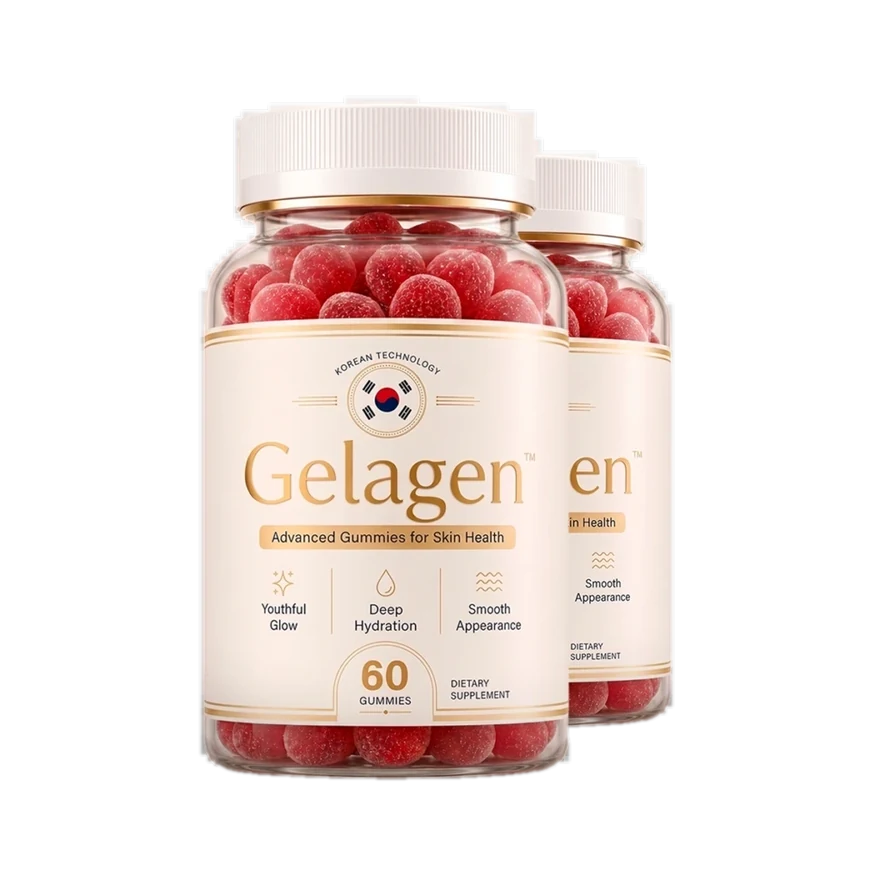
The panel prints vitamin E as d-alpha tocopheryl acetate, 7.4 mg per two-gummy serving, and prints an amount and a form beside most of the other rows too.
Order GelagenHow to read any vitamin E line
Four questions get you most of the way through any vitamin E entry, on this product or another.
- Does it say d- or dl-? The d- form is the natural stereoisomer, and dl- is the synthetic mixture with half the activity per milligram.
- Is it a free tocopherol or an ester? Esters such as the acetate are stable on a shelf and are converted in the body; the 1995 comparison found the plasma result equal to the free form.
- What unit is it in? Modern labels use milligrams of alpha-tocopherol. An IU figure is the older system.
- What percentage does it print, and does the arithmetic match? Here, 7.4 mg is 49 per cent of 15 mg, and it does.
Gelagen is a vitamin and mineral gummy sold for skin, hair and nails. This piece explains what a line on its label means. It is not a claim that the gummy treats any condition, and anyone who takes a prescription medicine or has a diagnosed condition should speak to a clinician before starting a supplement. The seller publishes no trial of the finished product.
The words on the vitamin E line tell you which form is used, that it is expressed in modern milligrams, and that the body can unwrap it; they do not tell you that 7.4 mg will change your skin, and no source cited here says it does.
The other rows raise different questions, and two of them have their own pieces: methylcobalamin at 6 mcg and twenty milligrams of vitamin C. The ingredients page reproduces the whole panel in label order.
Sources
- Traber MG. Vitamin E regulatory mechanisms. Annu Rev Nutr. 2007;27:347-362. https://pubmed.ncbi.nlm.nih.gov/17439363/
- U.S. Food and Drug Administration. Food Labeling: Revision of the Nutrition and Supplement Facts Labels. Federal Register 81 FR 33742, 27 May 2016 (preamble, comments 432 to 436 on vitamin E). https://www.govinfo.gov/content/pkg/FR-2016-05-27/html/2016-11867.htm
- Hosomi A, Arita M, Sato Y, Kiyose C, Ueda T, Igarashi O, Arai H, Inoue K. Affinity for alpha-tocopherol transfer protein as a determinant of the biological activities of vitamin E analogs. FEBS Lett. 1997;409(1):105-108. https://pubmed.ncbi.nlm.nih.gov/9199513/
- Cheeseman KH, Holley AE, Kelly FJ, Wasil M, Hughes L, Burton G. Biokinetics in humans of RRR-alpha-tocopherol: the free phenol, acetate ester, and succinate ester forms of vitamin E. Free Radic Biol Med. 1995;19(5):591-598. https://pubmed.ncbi.nlm.nih.gov/8529918/
- Reboul E. Vitamin E Bioavailability: Mechanisms of Intestinal Absorption in the Spotlight. Antioxidants (Basel). 2017;6(4):95. https://pubmed.ncbi.nlm.nih.gov/29165370/
- Traber MG, Burton GW, Hughes L, Ingold KU, Hidaka H, Malloy M, Kane J, Hyams J, Kayden HJ. Discrimination between forms of vitamin E by humans with and without genetic abnormalities of lipoprotein metabolism. J Lipid Res. 1992;33(8):1171-1182. https://pubmed.ncbi.nlm.nih.gov/1431596/
- Burton GW, Traber MG, Acuff RV, Walters DN, Kayden H, Hughes L, Ingold KU. Human plasma and tissue alpha-tocopherol concentrations in response to supplementation with deuterated natural and synthetic vitamin E. Am J Clin Nutr. 1998;67(4):669-684. https://pubmed.ncbi.nlm.nih.gov/9537614/
- Hoppe PP, Krennrich G. Bioavailability and potency of natural-source and all-racemic alpha-tocopherol in the human: a dispute. Eur J Nutr. 2000;39(5):183-193. https://pubmed.ncbi.nlm.nih.gov/11131364/
- Eberlein-König B, Placzek M, Przybilla B. Protective effect against sunburn of combined systemic ascorbic acid (vitamin C) and d-alpha-tocopherol (vitamin E). J Am Acad Dermatol. 1998;38(1):45-48. https://pubmed.ncbi.nlm.nih.gov/9448204/
- Traber MG, Atkinson J. Vitamin E, antioxidant and nothing more. Free Radic Biol Med. 2007;43(1):4-15. https://pubmed.ncbi.nlm.nih.gov/17561088/
More about Gelagen
Order Gelagen
Thirteen printed amounts and two gummies a day.
$79 down to $49 a bottle
Order Gelagen