Gelagen Official Website › Blog › Folate And B12 On The Same Panel: What The Masking Question Actually Means
Gelagen long readFolate And B12 On The Same Panel: What The Masking Question Actually Means
Folic acid alone has a documented history of hiding a B12 problem. This panel does not print folate alone, and that distinction is the entire subject of this page.
Two lines, printed together
The Gelagen Supplement Facts panel prints Folate at 442 mcg DFE, 110 per cent of the Daily Value, and Vitamin B12 at 6 mcg as methylcobalamin, 250 per cent of the Daily Value. Both figures are per two-gummy serving, printed a few rows apart on the same panel.
That pairing matters because folic acid, taken by itself, has one of the longer-running cautions in nutrition medicine attached to it: in someone with an undiagnosed vitamin B12 deficiency, folic acid can correct the anemia that deficiency causes while doing nothing for the nerve damage that comes with it, removing the warning sign a clinician would otherwise have used to catch the underlying problem. This page is about what that caution actually requires to happen, and what changes when the B12 is sitting right next to the folate rather than absent from the formula.

Where the masking concern actually comes from
The clearest single account of this history is a 1995 review in QJM by C.J. Dickinson, written specifically to ask whether folic acid harms people with vitamin B12 deficiency. It traces the concern to the era before B12 therapy existed. Before 1930, patients with pernicious anemia who survived the anemia itself went on, in many cases, to develop peripheral neuritis and subacute combined degeneration of the spinal cord — a serious, progressive nerve disease — and eventually died of it. From 1947 onward, once folic acid became available, a number of reports described rapid neurological deterioration in pernicious anemia patients who were given folic acid as their only treatment.
Dickinson's review then does something genuinely useful: it goes back to the clinical literature from before vitamin B12 therapy existed and finds that neurological deterioration in untreated pernicious anemia patients was often just as rapid and severe as in the folic-acid-treated cases. That does not erase the underlying mechanism, which is real and worth naming plainly: oral folic acid can correct, or prevent, the anemia of a B12 deficiency, because both nutrients feed the same DNA synthesis pathway at the point where a folate-dependent step is the one that is actually blocked. Correcting the visible sign of the deficiency, the anemia, without correcting the underlying B12 shortfall can let the separate, B12-specific nerve damage continue in the background, undetected, if a clinician is relying on anemia as the signal that something is wrong.
That is the actual mechanism behind the caution, and it is specific: it describes folic acid given as sole therapy, to a person who already has an undiagnosed vitamin B12 deficiency, at a dose adequate to visibly correct the resulting anemia.
What it took to hide a problem, and what this panel prints
Dickinson's review is also specific about dose in a different sense. It states plainly that even at a large dose — 20 mg of folic acid a day — folic acid has never been shown to harm a normal person directly. The bad reputation it acquired came entirely from its effect in pernicious anemia, not from any documented toxicity of the folic acid itself.
Set that 20 mg figure beside this panel's 442 mcg, which is 0.442 mg. Twenty milligrams divided by 0.442 mg is about forty-five: this panel's folate line is roughly a forty-fifth of the dose Dickinson's review names as never having shown harm in a normal person, and the doses used historically to correct pernicious anemia's visible symptoms outright — the doses actually implicated in the masking case reports — sat in that same large-dose territory, not in the range a two-gummy beauty serving prints.
| Figure | What it is |
|---|---|
| 442 mcg DFE (0.442 mg) | What this panel prints per two-gummy serving (110% of the FDA Daily Value) |
| 400 mcg DFE | The FDA Daily Value for folate used to calculate the panel's percentage column |
| 20 mg | The large folic-acid dose Dickinson's 1995 review names as never shown to harm a normal person, roughly 45 times this panel's amount |
This site is not aware of a masking case report built around a folate dose close to 442 mcg DFE, and does not claim one exists.
There is a second gap worth naming plainly, because it is the kind of thing a careful label reader would want flagged rather than smoothed over. This panel's row reads simply “Folate” with an amount in DFE and no form specified, unlike several of the panel's other rows, which name the exact compound — ascorbic acid for vitamin C, methylcobalamin for B12, pyridoxine HCl for B6. The historical masking literature discussed above is specifically about folic acid, the synthetic compound used in fortification and most supplements, and DFE, or Dietary Folate Equivalents, is a unit built to let food folate, folic acid taken with food, and folic acid taken on an empty stomach be compared on one scale, because they are absorbed at different efficiencies. A DFE figure alone does not tell a reader which of those forms, or which blend of them, sits behind the number. Readers who want that level of detail should look for it directly from the manufacturer rather than assume; this site reports what the panel states and no more.
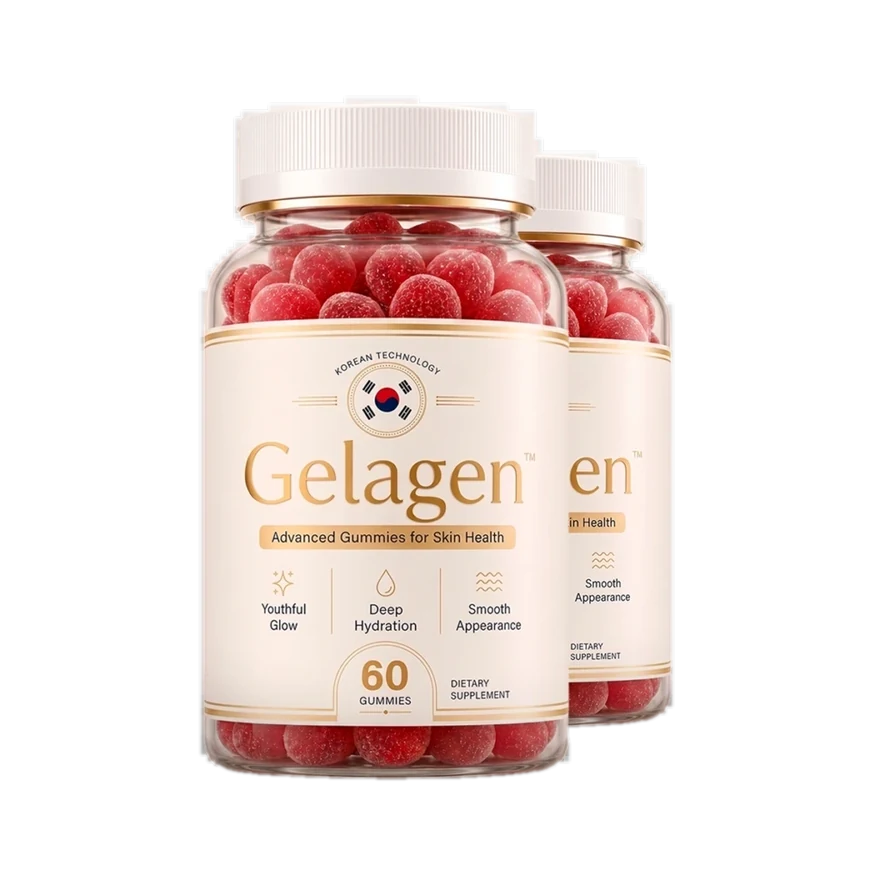
Gelagen on the official website
The panel prints folate and B12 on the same label, each an exact figure rather than folded into an unnamed blend.
Order GelagenWhy pairing the two changes the picture
The masking mechanism Dickinson describes depends on one specific setup: folic acid given alone, without B12, to someone who is already short of B12. Remove either half of that setup and the mechanism does not have anything to work with. This label does not present folate on its own the way an isolated folic acid tablet, or a food fortified with folic acid but nothing else, would. It pairs 442 mcg DFE of folate with 6 mcg of B12, printed as methylcobalamin, on the same two-gummy serving — a B12 amount that is itself 250 per cent of the Daily Value.
That does not mean a co-formulated product makes a real, underlying B12 deficiency vanish, and it is worth being precise about why not. A 2008 review by Carmel in Food and Nutrition Bulletin, focused specifically on the efficacy and safety of B12 fortification and supplementation, makes the point that B12's bioavailability from an oral dose is limited, and that people who actually need extra B12 the most — those with malabsorption affecting either classical intrinsic-factor-mediated absorption or food-bound B12 release — often respond poorly to modest oral doses. A gummy supplying B12 alongside folate is a meaningfully different situation from folic acid given completely alone, but it is not a substitute for diagnosing a genuine absorption problem in someone who has one. What it changes is the specific historical mechanism this page is about: the visible-anemia signal is not being removed by an isolated folic acid dose here, because the B12 is printed on the same line.
- The classical masking concern needs folic acid given alone, without B12.
- This panel prints both nutrients on the same two-gummy serving.
- Co-formulation is not the same as ruling out a genuine, separately caused B12 shortfall.
- Someone with real risk factors for B12 deficiency still needs that checked directly, not inferred from a supplement label.
What a B12 shortfall looks like when it is not hidden
A 2004 review in CMAJ by Andrés and colleagues, focused on B12 deficiency in elderly patients, is a useful companion here because it describes what the condition looks like on its own terms, independent of the masking question entirely. The review reports that B12 deficiency occurs in more than 20 per cent of elderly people and is frequently unrecognised, because its clinical signs are subtle. It identifies food-cobalamin malabsorption — the inability to release B12 from food, or a shortfall in the intestinal transport proteins that carry it — as the most common cause, accounting for more than 60 per cent of cases, with classical pernicious anemia responsible for 15 to 20 per cent and insufficient dietary intake and other malabsorption making up the remainder.
The manifestations the review describes run wider than anemia: it specifically flags neuropsychiatric and hematological effects as the two domains where a real deficiency does the most damage, and it is the neuropsychiatric side — not the blood count — that a masked deficiency would leave unaddressed. That is precisely why the historical caution about folic acid exists, and precisely why co-formulating B12 alongside folate removes the specific mechanism that caution describes, without removing the underlying need for anyone with real risk factors to have their B12 status checked directly rather than assumed.
The same review is explicit that this is a diagnostic and management problem, not only a descriptive one: alongside its account of prevalence and causes, it reviews strategies for recognising and treating cobalamin deficiency in a population where the textbook picture — a low red-cell count with a large cell size — is often absent or mild by the time the condition is caught. That is the same blind spot the historical folic-acid caution created deliberately, from a different starting point: both describe a route by which the anemia stops being a reliable early-warning sign, one through masking and one through a presentation that was simply always going to be subtle. The practical lesson is identical either way. Anyone with plausible risk factors for a B12 shortfall is better served by a direct blood test than by reasoning about it from a supplement label, this one included.
Reading a folate line honestly
Four things follow from all of this, and none of them asks a reader to take this page's word over a clinician's.
- The masking mechanism is real, and it is specific. It requires folic acid given alone, at a dose adequate to correct visible anemia, to someone already short of B12.
- This label does not create that setup. Folate and B12 are printed on the same serving, at 110 per cent and 250 per cent of their respective Daily Values.
- Risk factors for B12 deficiency are still worth knowing. Age, reduced stomach acid, certain medications, gastric surgery and a vegan diet are all recognised contributors to food-cobalamin malabsorption, and none of them is ruled out by taking a beauty gummy.
- A gummy is not a diagnostic tool. Gelagen is formulated for skin, hair and nails, not as a treatment for anemia or a documented B12 deficiency, and nothing on this page should be read as replacing bloodwork for anyone with symptoms or risk factors.
Folic acid given alone can hide a B12 problem behind a corrected blood count; this panel prints B12 on the same serving as the folate, which removes the specific mechanism behind that caution without replacing an actual blood test for anyone who has reason to want one.
It is worth restating what this page is not saying, because a masking question is easy to overstate in either direction. It is not saying folate is dangerous — Dickinson's review is explicit that even a 20 mg dose has never been shown to harm a normal person. It is not saying a co-formulated gummy is a treatment for B12 deficiency, pernicious anemia, or any diagnosed condition; Gelagen is not marketed or intended as one. What it is saying is narrower and more useful than either of those: the specific historical mechanism by which folic acid hides a B12 problem needs folic acid alone, and this label does not print folate alone.
Folate and B12 are two of thirteen printed amounts on this panel, and each is easier to judge next to the others than alone. All thirteen are set against their reference intakes here, and this site's separate page on the B12 line covers what that 250 per cent figure does and does not mean for absorption.
Sources
- Dickinson CJ. Does folic acid harm people with vitamin B12 deficiency? QJM. 1995;88(5):357-364. https://pubmed.ncbi.nlm.nih.gov/7796091/
- Andrés E, Loukili NH, Noel E, Kaltenbach G, Abdelgheni MB, Perrin AE, Noblet-Dick M, Maloisel F, Schlienger JL, Blicklé JF. Vitamin B12 (cobalamin) deficiency in elderly patients. CMAJ. 2004;171(3):251-259. https://pubmed.ncbi.nlm.nih.gov/15289425/
- Carmel R. Efficacy and safety of fortification and supplementation with vitamin B12: biochemical and physiological effects. Food Nutr Bull. 2008;29(2 Suppl):S177-S187. https://pubmed.ncbi.nlm.nih.gov/18709891/
- Gelagen Supplement Facts panel, as reproduced on this website. https://gelagendaily.com/supplement-facts.html

Order Gelagen on the official website
Thirteen printed amounts, two gummies a day, and 60 days from the date of purchase to decide.
$79 down to $49 a bottle · money back for 60 days after you buy
Order Gelagen On The Official WebsitePaid at the seller’s checkout · 60-day money-back guarantee · lot GEL-26/GE-6615