Gelagen Official Website › Blog › Why The Label Says “Before A Meal”
Gelagen long readWhy The Label Says “Before A Meal”
Gelagen’s instructions say to take the gummies about 30 minutes before a meal. Three of the thirteen nutrients on the panel are the entire reason that instruction exists.
What the instruction actually says
Gelagen’s own how-to-use instructions read, in full: two gummies once a day, with a full glass of water, about 30 minutes before a morning or afternoon meal. Three of those four elements are generic serving housekeeping. The fourth — the timing, specifically before a meal rather than whenever is convenient — has a direct chemical reason behind it, and the reason sits on the Supplement Facts panel rather than anywhere in the instructions themselves.
This page is about that reason: which nutrients on the panel it applies to, why it applies to them and not to the other ten, and what the underlying trial evidence actually measured rather than what marketing language usually implies it measured.
Two kinds of vitamin, one absorption route
Vitamins split into two families based on one physical property: whether they dissolve in water or in fat. That single property decides almost everything about how each one moves through digestion. Vitamin C, the eight B vitamins, and choline are water-soluble: they dissolve directly into the watery contents of the gut and pass into the bloodstream through the same route water itself takes, largely independent of whatever else was eaten alongside them.
Vitamins A, D, E and K are the exception, and they are exceptions for the same structural reason: none of them dissolves in water at all. Three of the four are on the Gelagen panel — vitamin A as retinyl acetate at 630 mcg, vitamin D as cholecalciferol at 10 mcg, and vitamin E as d-alpha tocopheryl acetate at 7.4 mg. Those three rows, and only those three rows out of thirteen, are the ones the “before a meal” instruction is actually written for.
| Nutrient | Solubility | Needs fat present to absorb well? |
|---|---|---|
| Vitamin A (retinyl acetate) | Fat-soluble | Yes |
| Vitamin D (cholecalciferol) | Fat-soluble | Yes |
| Vitamin E (d-alpha tocopheryl acetate) | Fat-soluble | Yes |
| Vitamin C, B6, B12, folate, biotin, pantothenic acid, choline, iodine, zinc, inositol | Water-soluble (or, for zinc and iodine, mineral) | No |

Why fat is the missing ingredient, not the gummy
Absorbing a fat-soluble vitamin is a multi-step process, and dietary fat is a required input at more than one of those steps, not a minor assist at just one.
- Bile has to be released. The gallbladder releases bile in response to fat entering the small intestine specifically. Eating on an empty stomach, or eating a meal with almost no fat in it, triggers a smaller bile release than a meal that contains fat.
- Bile has to build micelles. Fat-soluble vitamins cannot cross the watery layer that lines the gut on their own. Bile acids surround them, along with dietary fat, into microscopic particles called micelles, which is the only form in which a fat-soluble vitamin can reach the absorptive cells lining the intestine.
- The vitamin has to leave in a chylomicron. Once inside the intestinal cell, fat-soluble vitamins are packaged into chylomicrons — fat-transport particles — and carried out through the lymphatic system rather than directly into the bloodstream the way water-soluble nutrients travel. Building a chylomicron requires dietary fat as a structural component, not only as a trigger.
Skip dietary fat at all three of those steps and a meaningful share of a fat-soluble dose can pass through the gut largely unabsorbed. None of that is specific to a gummy, a capsule or any particular brand; it is the same chemistry for any vitamin A, D or E, from any source, taken any way. It is also the same chemistry behind a related, better-known piece of advice: people with conditions that impair fat digestion or fat absorption — Crohn’s disease, coeliac disease and ulcerative colitis among them — are specifically flagged in the government’s own literature as being at higher risk of poor absorption of vitamins A, D, E and K, for exactly the reason described in the three steps above: the vitamin travels with fat, so a gut that struggles with fat struggles with these four nutrients alongside it.
Gelagen, straight from the label
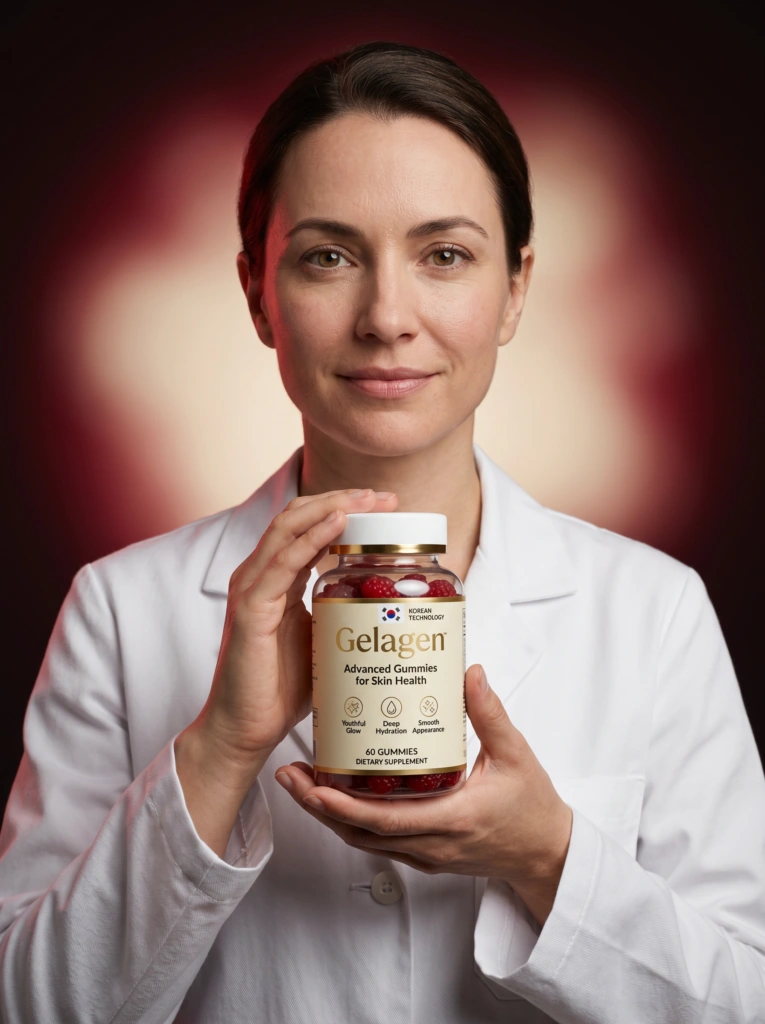
Three of the thirteen amounts on the Gelagen panel are fat-soluble vitamins, and the “before a meal” instruction on the bottle is written for those three specifically.
Order GelagenWhy thirty minutes, specifically
Neither Gelagen’s supplier nor the published research this page cites publishes a pharmacokinetic study of the gummy itself, so this section is honest about what it can and cannot claim about the specific number thirty. What the general digestive physiology in the section above supports is the direction and the rough window, not a precisely studied optimum: bile release and micelle formation both ramp up once fat starts reaching the small intestine, and reaching the intestine from the stomach takes on the order of minutes rather than seconds for a small swallowed item taken with water. A gap of roughly half an hour is long enough for the gummies to have started moving out of the stomach by the time a meal’s fat content arrives behind them, without being so long that the two are digested as fully separate, disconnected events hours apart.
That is a reasonable buffer built from how digestion generally sequences, not a number this page can trace to a trial that tested 30 minutes specifically against, say, 15 or 45. Readers who take the gummies 10 minutes before a meal instead of 30, or right alongside the first bite, are very unlikely to meaningfully change the outcome the mechanism describes; readers who take them mid-morning with no meal for another three hours are the ones actually working against the mechanism, regardless of which precise number of minutes separates dose from food.
What the trial evidence actually measured
The mechanism above is textbook physiology, and it has also been tested directly, in a randomised trial specific to vitamin D rather than inferred from theory alone. A 2015 trial published in the Journal of the Academy of Nutrition and Dietetics randomised 50 healthy older men and women to take a single 50,000 IU dose of vitamin D3 alongside one of three meals: a fat-free meal, or a meal with 30 per cent of its calories from fat, in one of two different fat compositions.
The result was a clear, statistically significant gap. Peak plasma vitamin D3 twelve hours after the dose was 32 per cent higher, on average, in the people who ate a fat-containing meal than in the people who ate the fat-free meal (95% CI 11–52%, P=0.003). The two different fat-containing meals performed about the same as each other — the composition of the fat did not matter much — but the presence of fat at all made a measurable, meaningful difference to how much vitamin D actually reached the bloodstream.
That is one trial, using a large single research dose of vitamin D3 specifically, not a study of Gelagen or of gummies as a format. It is included here because it is the clearest published demonstration of the exact mechanism section three describes, run as a controlled experiment rather than assumed from first principles.
| Meal type | Peak plasma vitamin D3, 12 hours |
|---|---|
| Fat-free meal | Reference (lowest) |
| Meal with 30% of calories as fat | 32% higher on average than the fat-free meal (P=0.003) |
How much fat actually counts
The 2015 trial's fat-containing meals derived 30 per cent of their calories from fat, which is squarely inside the range of an ordinary Western meal rather than a deliberately high-fat test condition — it is close to the general dietary guideline most public health bodies use as an upper target for fat’s overall share of daily calories, not a fraction anyone would need to engineer specially. A meal built around eggs, a serving of dairy, a tablespoon of oil used in cooking, a handful of nuts, or fish, meat or avocado in ordinary portions comfortably reaches that share.
A meal that is not like that — black coffee, a piece of plain fruit, a plain rice cake, or juice with nothing else — is close enough to the trial’s fat-free comparison group that the mechanism this page describes has little to work with. The instruction is not asking for a rich or indulgent meal; it is asking for an ordinary one that is not deliberately fat-free.
| Usually enough fat present | Usually not enough |
|---|---|
| Eggs, yoghurt or milk, oil-cooked food, nuts, avocado, meat or fish | Black coffee or tea alone |
| A normal mixed breakfast or lunch | Plain fruit, dry toast or a rice cake with nothing on it |
| Most restaurant or home-cooked meals | Juice or a sugar-sweetened drink with nothing solid |
What “before a meal” does and does not require
It does not require a large meal, and it does not require any specific type of fat. The trial above found no meaningful difference between two very different fat compositions, and the bile-and-micelle mechanism needs dietary fat to be present, not a particular kind of it. An ordinary breakfast or lunch containing some fat — eggs, dairy, oil used in cooking, nuts, or any other everyday source — satisfies the same mechanism a controlled research meal does.
It does require food to actually follow the gummies within a reasonable window. Taking the serving thirty minutes before a meal times the gummies to be moving through the stomach and into the small intestine at roughly the same point the meal’s fat arrives, rather than hours apart from any food at all. A serving taken on a genuinely empty stomach, with no meal following for hours, is the scenario the instruction exists to avoid.
- The ten water-soluble and mineral rows on the panel are not the reason for the instruction. Vitamin C, the B vitamins, choline, iodine, zinc and inositol absorb by a different route and do not depend on dietary fat the same way.
- Any ordinary meal with some fat in it satisfies the mechanism. A research-grade controlled meal is not required; an everyday breakfast or lunch is what the instruction is actually timed around.
- The instruction is about degree, not an on/off switch. Taking the gummies with no fat nearby at all does not mean zero absorption of vitamins A, D and E; it means a smaller share of the dose reaches the bloodstream than it would have alongside a normal meal.
This page explains the mechanism behind a printed serving instruction. It is not a claim that timing alone changes how Gelagen performs for any individual, and anyone with a condition that affects fat digestion or fat absorption should raise that specifically with a clinician rather than relying on general timing advice.
The short version: “about 30 minutes before a meal” is not a generic wellness habit printed onto a bottle. It is a specific, testable instruction written for three specific rows on the panel — vitamin A, vitamin D and vitamin E — because those three, and only those three, need dietary fat present to be absorbed at their intended rate.
Vitamins A, D and E are fat-soluble, fat-soluble vitamins require dietary fat at three separate points in digestion to absorb well, and a randomised trial measuring this directly for vitamin D found a 32 per cent higher peak blood level when the dose was taken with a fat-containing meal rather than a fat-free one.
How chewing rather than swallowing changes the picture further is a separate question, answered in full on what the gummy format actually changes, and the ingredients page reproduces every row this page refers to in label order.
Sources
- Dawson-Hughes B, Harris SS, Palermo NJ, Ceglia L, Rasmussen H. Dietary fat increases vitamin D-3 absorption. J Acad Nutr Diet. 2015;115(2):225-230. https://pubmed.ncbi.nlm.nih.gov/25441954/
- NIH Office of Dietary Supplements. Vitamin D: Fact Sheet for Health Professionals. https://ods.od.nih.gov/factsheets/VitaminD-HealthProfessional/
- NIH Office of Dietary Supplements. Vitamin A and Carotenoids: Fact Sheet for Health Professionals. https://ods.od.nih.gov/factsheets/VitaminA-HealthProfessional/
- NIH Office of Dietary Supplements. Vitamin E: Fact Sheet for Health Professionals. https://ods.od.nih.gov/factsheets/VitaminE-HealthProfessional/

Order Gelagen on the official website
Thirteen printed amounts, two gummies a day, and 60 days from the date of purchase to decide.
$79 down to $49 a bottle · money back for 60 days after you buy
Order Gelagen On The Official WebsitePaid at the seller’s checkout · 60-day money-back guarantee · lot GEL-26/GE-6615